Menu

How it works

Five steps, and the limit of each one.

Every step below names the data it reads. Where a step cannot answer, the report says so rather than guessing, which is why the third block of the report exists at all.

  1. 01

    The application arrives

    Your ATS, email, or upload

    A CV comes in through your ATS, by email, or by upload.

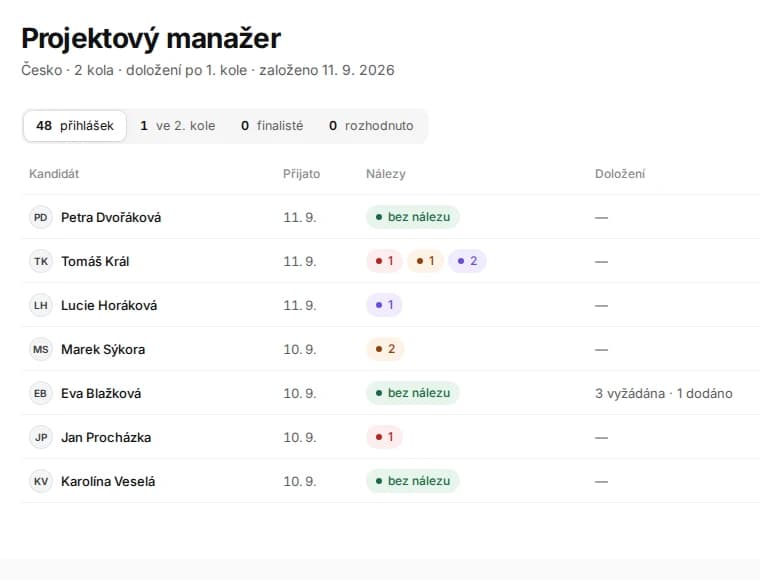
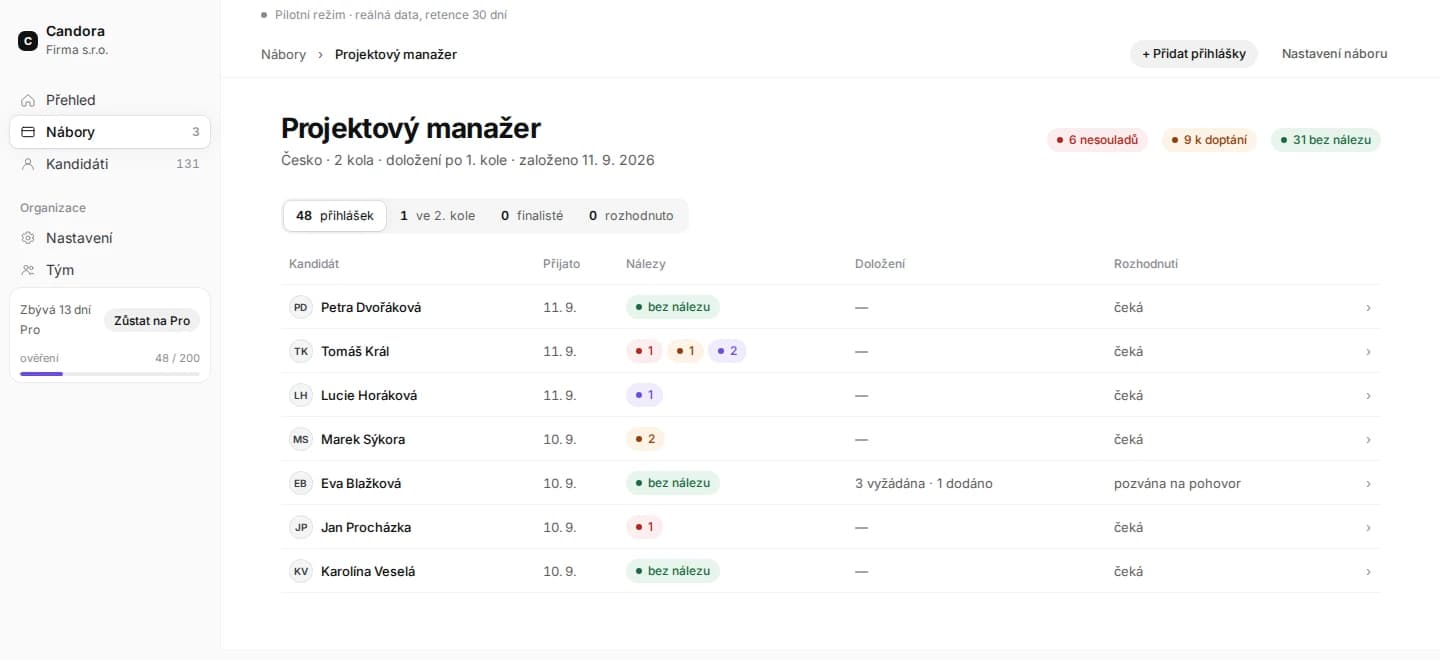
    The candidate queue in Candora. Three intake routes across the top: email forwarding, manual upload and an ATS connector. Below them a table of applications with their state and how many documents have arrived.The candidate queue in Candora. Three intake routes across the top: email forwarding, manual upload and an ATS connector. Below them a table of applications with their state and how many documents have arrived.
  2. 02

    Claims are extracted

    Extraction model hosted in the EU under a processing agreement

    The CV becomes a list of separate, checkable claims: employer, role, start and end date, contact details, document metadata.

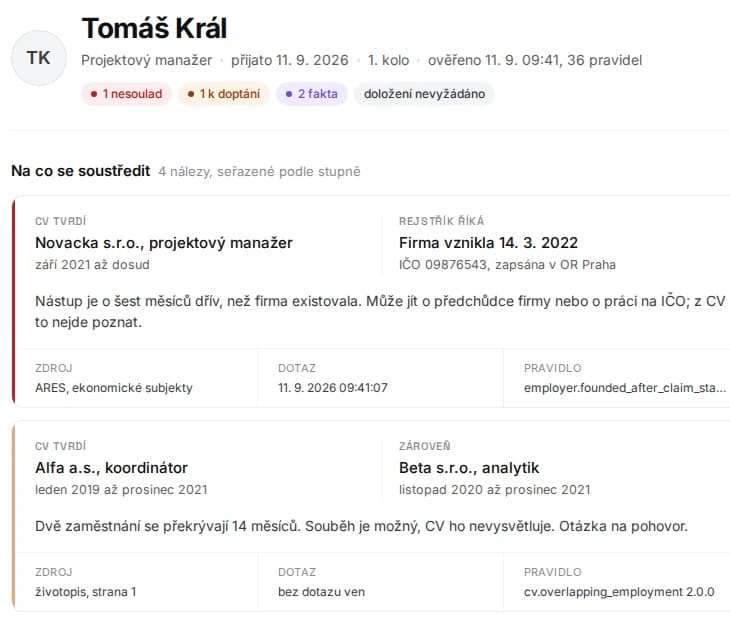
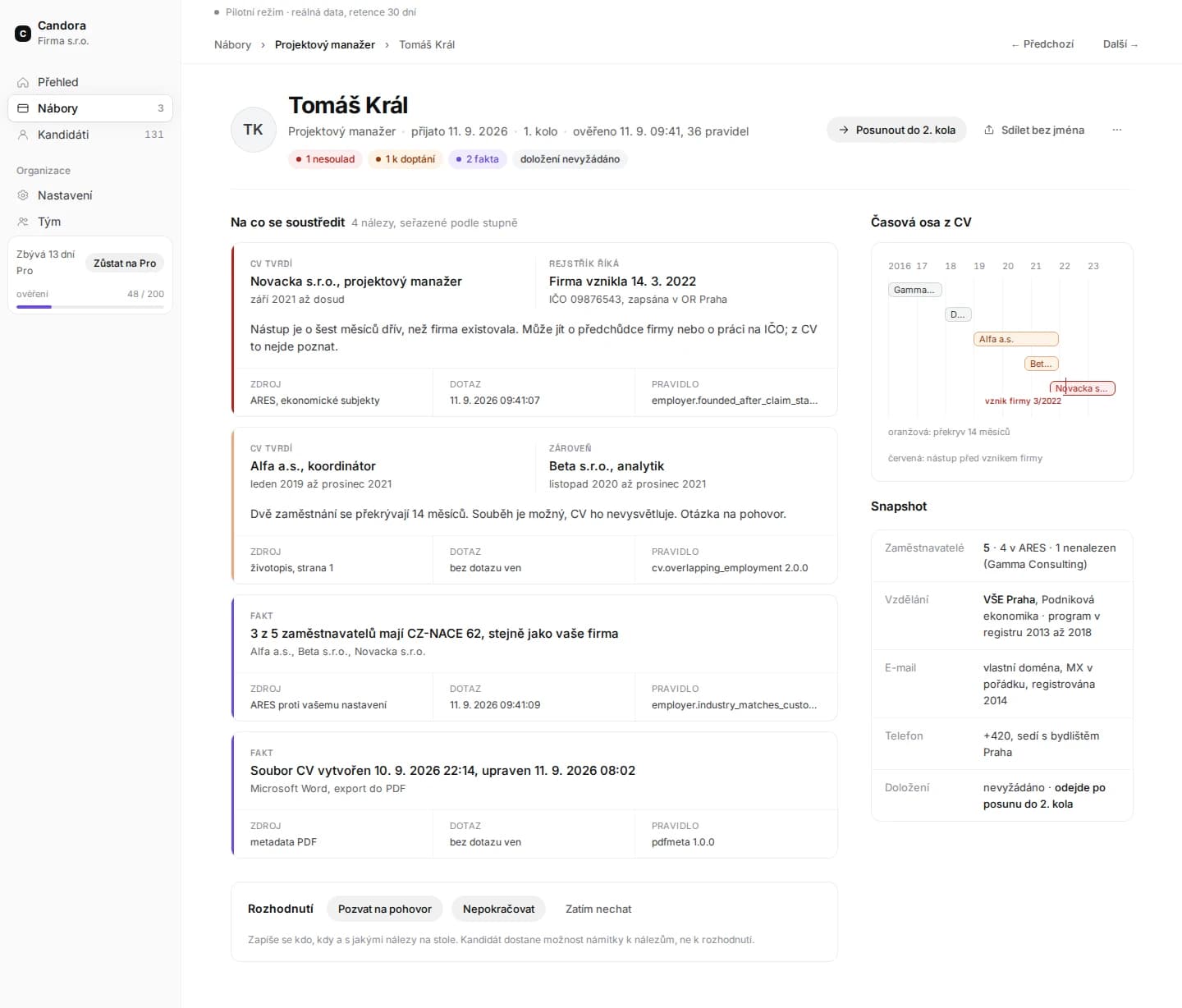
    A candidate in Candora. Step one of two asks you to confirm what was read out of the CV: three employers and a school, each with dates and the page it came from. Findings stay hidden until a person confirms the reading.A candidate in Candora. Step one of two asks you to confirm what was read out of the CV: three employers and a school, each with dates and the page it came from. Findings stay hidden until a person confirms the reading.
  3. 03

    Each claim is checked against a source

    ARES and EU business registries, RDAP, web archive, DNS, numbering plans

    Company registries confirm whether the employer existed and for how long.

  4. 04

    The evidence report is written

    Candora

    Findings, verified claims and unverifiable claims go into three separate blocks.

  5. 05

    A person decides

    Your team

    The recruiter reads the report, agrees or overrides, and records what they did.

The five steps above are one layer. There is a second, and it does not start by itself.

Everything above runs on every application that arrives.

  • Right to work: the expiry date on the document the candidate supplies. No public register holds this for an employer to query.
  • Education: whether the school and programme were accredited during the period claimed.
  • Verification a candidate requests: the candidate passes a link to someone who can confirm one detail, and that person answers.

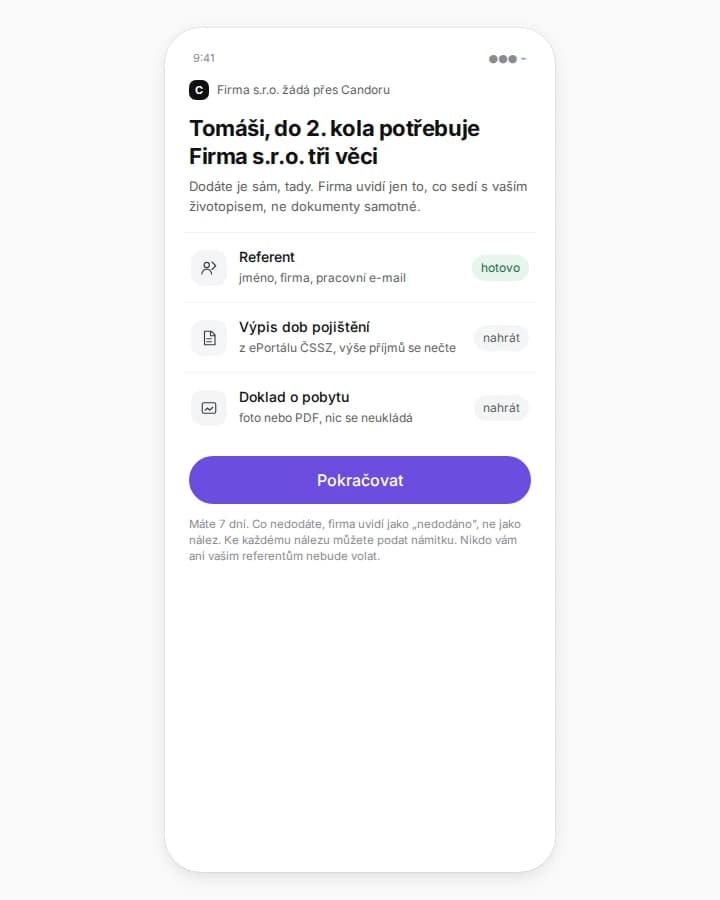
This layer only ever runs after a person asks for it, on a candidate they selected. There is no setting that turns it on for everyone. Asking three hundred applicants for documents is disproportionate under GDPR, and the database refuses to record a run of this layer without a record of the human who requested it.

The candidate flow in Candora at mobile width. It opens by saying Candora is neither the employer nor an agency. Below is the list of requested documents and, for each, what was read from it and what was discarded.The candidate flow in Candora at mobile width. It opens by saying Candora is neither the employer nor an agency. Below is the list of requested documents and, for each, what was read from it and what was discarded.
Right to work dates, once the person is hired

What the process deliberately does not do

These are not gaps waiting to be filled.

  • It does not produce a score, a risk level or a probability at any point in the pipeline.
  • It does not reject, and there is no code path that could.
  • It does not send the candidate's name to any external source.
  • It does not read anything on the candidate's device.
  • It does not merge identities across customers without a human confirmation recorded in the database.
  • It does not keep the CV file. Retention applies to the claims, and defaults to 30 days.

A number, or a document

The same line from a CV, two different outputs. Switch between them and compare what each one lets you check.

The applicant states March 2018 to June 2019 at Studio Orbit s.r.o.

Conflict
Source
Company register
Queried
12 Aug 2026, 9:41
Rule version
employer.founded_after_claim_start 0.9.0

Every one of those parts is required in the database, so a finding cannot exist without them.

What a finding is made of

Every part is required in the database, so a finding cannot exist without any one of them and cannot be filled in by hand.

Conflict

Studio Orbit s.r.o. was founded on 14 January 2019, and the applicant states a period starting in March 2018.

Source
Company register
Queried
12 Aug 2026, 9:41
Rule version
employer.founded_after_claim_start 0.9.0

Why you are seeing this

The rule compares the company founding date with the first day of the stated period. It reports only when the period starts before the company existed, by more than zero days. The founding date is a field in the register, not something derived.
  1. Source

    The source is a named register, not a generic word.

  2. Queried

    The query time says which moment the result holds for.

  3. Rule version

    The rule key and version make it possible to trace exactly what produced the finding.

A candidate in Candora. Step one of two asks you to confirm what was read out of the CV: three employers and a school, each with dates and the page it came from. Findings stay hidden until a person confirms the reading.A candidate in Candora. Step one of two asks you to confirm what was read out of the CV: three employers and a school, each with dates and the page it came from. Findings stay hidden until a person confirms the reading.

The things people ask first.

Is this a background check?

No. A background check is a records search on one person, run late, on the candidate who already has an offer, and it costs enough that you run it once. Candora runs at the top of the funnel on every application, reads different sources, and returns findings rather than a record extract. Many customers will want both.

Do you scrape LinkedIn?

No. Candora reads data the candidate or the recruiter provides, plus public registries and APIs that permit the use. Scraping a professional network for hiring decisions does not have a defensible legal basis in the European Union and we did not want the product built on one.

What happens to a candidate with almost no digital footprint?

Nothing. An absent footprint is never a finding. Claims we cannot check land in the third block of the report, marked as not verified, with the reason. That block is descriptive, not negative.

Can Candora reject a candidate automatically?

No. Candora never rejects anyone on its own. There is no automatic rejection and no default decision in the product. Every decision carries the user account of the person who recorded it and the time, and the database will not accept it without an account. This is deliberate and in line with Article 22 GDPR, which gives candidates, with limited exceptions, the right not to be subject to a decision based solely on automated processing.

What does the candidate see?

Whatever you decide to show them, and we make that easy rather than awkward. Every finding is written as a sentence a person can read, with the register it came from, so a recruiter can raise it in a call without accusing anyone.

Where does the data live?

In an EU region. Database, object storage and the functions that process requests. The CV file itself is never written to disk: it is parsed from the request and the text is discarded after extraction.

Which ATS do you work with?

On day one, email and upload, so nothing has to be integrated before you can use it. Integrations come later, driven by what the first customers actually run. Candora is a layer, not a replacement for your ATS.

The fastest way to understand it is to run one.

Sample candidates, the same rules, ninety seconds, no signup.

See a live reportGet access